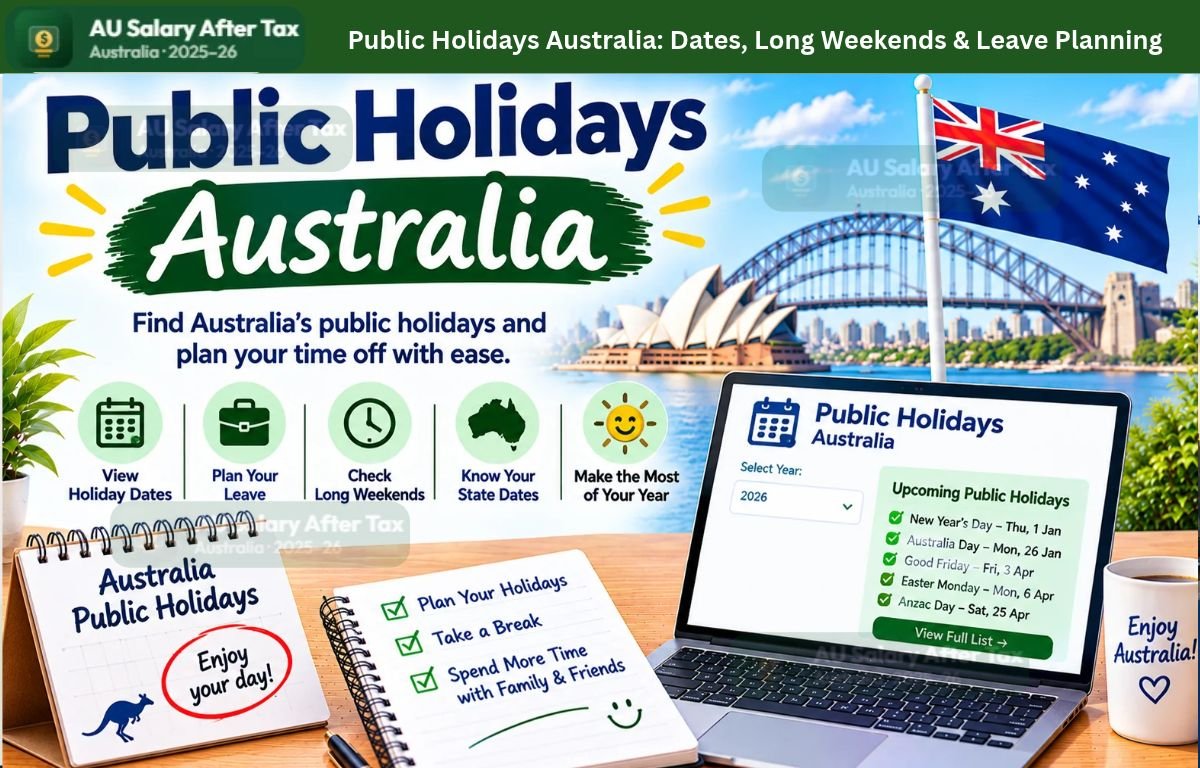
Christmas Day 2026 falls on a Friday. Boxing Day falls on a Saturday, so most states add Monday 28 December as well — four days off without touching your annual leave. This Public Holidays Australia guide lists every date for 2026 and 2027, what you get paid, and the penalty rates when you work.
Important: All figures are for 2026–27 unless a year is stated. Public Holidays Australia dates depend on where your job is based. Penalty rates come from your award or agreement, not from a single national rate.
The Fair Work Act names eight national public holidays: New Year’s Day, Australia Day, Good Friday, Easter Monday, Anzac Day, the King’s Birthday, Christmas Day and Boxing Day. Each state and territory adds its own days under state law, and those state days carry the same pay rules.
Three rules sit underneath every date here. First, you get the public holidays of the place where your job is based, not where you are working that day — the Fair Work Ombudsman gives the example of Cass, based in Melbourne, who still gets the Melbourne Cup holiday.
Second, Easter Sunday is a public holiday everywhere except Tasmania, but it is not one of the eight national holidays.
The Fair Work Ombudsman’s public holidays page lists the dates for your state. (Fair Work Ombudsman – Public holidays)
Table of Contents
Public Holidays Australia 2026 and 2027: The National Dates
The King’s Birthday is the only national day that moves: most states take the second Monday in June, Queensland the first Monday in October, and Western Australia a Monday in late September.
| Holiday | 2026 | 2027 |
|---|---|---|
| New Year’s Day | Thursday 1 January | Friday 1 January |
| Australia Day | Monday 26 January | Tuesday 26 January |
| Good Friday | Friday 3 April | Friday 26 March |
| Easter Monday | Monday 6 April | Monday 29 March |
| Anzac Day | Saturday 25 April | Sunday 25 April |
| King’s Birthday | Monday 8 June* | Monday 14 June* |
| Christmas Day | Friday 25 December | Saturday 25 December |
| Boxing Day | Saturday 26 December | Sunday 26 December |
* King’s Birthday 2026: 5 October in Queensland, 28 September in Western Australia. King’s Birthday 2027: 4 October in Queensland, 27 September in Western Australia.
Easter Sunday is Sunday 5 April 2026 and Sunday 28 March 2027, a public holiday everywhere except Tasmania. Easter Saturday is Saturday 4 April 2026 and Saturday 27 March 2027, a public holiday in New South Wales, Victoria, Queensland, South Australia, the ACT and the Northern Territory — in Queensland it is called the day after Good Friday.
State and Territory Holidays: How Many Days You Get
No two states get the same number of public holidays in Australia the ACT gets the most and Tasmania the fewest. The counts below are full-day statewide holidays, verified against the Fair Work Ombudsman and state lists.
| State or territory | 2026 | 2027 |
|---|---|---|
| Australian Capital Territory | 15 | 16 |
| New South Wales | 13 | 14 |
| Northern Territory | 13 | 14 |
| Queensland | 12 | 13 |
| South Australia | 13 | 13 |
| Tasmania | 9 | 10 |
| Victoria | 14 | 15 |
| Western Australia | 13 | 14 |
Labour Day falls on a different date almost everywhere: Western Australia 2 March 2026 (1 March 2027); Victoria and Tasmania 9 March 2026 (8 March 2027; Tasmania calls it Eight Hours Day); Queensland and the Northern Territory 4 May 2026 (3 May 2027; the NT calls it May Day); NSW, SA and the ACT 5 October 2026 (4 October 2027).
Other state-only days: Canberra Day and Reconciliation Day (ACT); Adelaide Cup Day (SA); the AFL Grand Final Friday and Melbourne Cup (VIC); WA Day (WA); Picnic Day (NT); and the Royal Queensland Show (Brisbane only).
When a Public Holiday Falls on a Weekend
A public holiday on a Saturday or Sunday does not just disappear. Public Holidays Australia rules differ by state: a substitute day replaces the weekend day, while an additional day is extra.
Boxing Day 2026 falls on Saturday 26 December, and most states add Monday 28 December: New South Wales, Victoria, Queensland, Western Australia, the Northern Territory and the ACT. In Tasmania, Boxing Day itself is Monday 28 December. In South Australia, Saturday 26 December is the Proclamation Day holiday, with Monday 28 December as the additional holiday.
Anzac Day 2026 falls on Saturday 25 April. The ACT, New South Wales and Western Australia add Monday 27 April; the other states do not. Anzac Day 2027 falls on Sunday 25 April: New South Wales, the ACT and Western Australia add Monday 26 April; Queensland and the Northern Territory observe it on Monday 26 April instead; Victoria, South Australia and Tasmania have no Monday holiday.
Christmas 2027 follows the same pattern: Christmas Day falls on Saturday 25 December and Boxing Day on Sunday 26 December, so every state adds Monday 27 December and Tuesday 28 December. In South Australia, Tuesday 28 December is the additional holiday for Proclamation Day; Tasmania takes Boxing Day itself that day.
Two part-day holidays cover evening hours only: Christmas Eve from 6pm to midnight in Queensland and from 7pm in South Australia and the Northern Territory (24 December 2026 and 2027), and New Year’s Eve from 7pm in South Australia and the Northern Territory (31 December 2026 and 2027). Penalty rates apply only to hours worked inside that window.
Public Holidays Australia: Do You Get Paid If You Don’t Work?
Yes — if you are full-time or part-time and the holiday falls on a day you would normally work. Section 116 requires your employer to pay your base rate for the ordinary hours you would have worked. The base rate excludes loadings, allowances, penalty rates, overtime and bonuses, and your roster cannot be changed to avoid this payment.
A part-time employee who never works Mondays is not paid for a Monday public holiday; one who does normally work that weekday is paid for it. Casual employees are not paid for a public holiday they do not work: casuals have no paid leave entitlements, and the 25% casual loading is the compensation for that. A casual is only paid if they work it, at the casual penalty rate.
Public Holiday Penalty Rates: What You Earn If You Work
There is no single national public holiday pay rate: your award or agreement sets the percentage of your base hourly rate — 225% means 2.25 times your ordinary rate for every hour you work. The Public Holidays Australia rates below are the standard rates under the most common awards, verified against the Fair Work Ombudsman pay guides for 2026–27. Casual percentages already include the 25% loading.
| Award | Full-time/part-time | Casual |
|---|---|---|
| Retail, Hospitality, Fast Food, Restaurant, Pharmacy | 225% | 250% |
| Most other awards (Clerks, SCHADS, Aged Care) | 250% | 275% |
| Nurses Award | 200% | 250% |
Two points catch people out. First, the public holiday rate replaces any weekend rate for those hours — it is not paid on top of it. Second, Easter Saturday is treated as a public holiday under the Retail Award, so it attracts the 225% or 250% rate, not the standard Saturday rate. If you are not sure which award covers you, the Fair Work Ombudsman’s Pay and Conditions Tool works it out from your job and hours.
Read more: Best Minimum Wage Calculator Australia: Complete Guide to the National Minimum Wage 2026–27
Public Holidays Australia: Worked Examples
Two Public Holidays Australia examples show what the rules are worth in dollars.
Example 1: Casual retail worker, 8 hours on Christmas Day
A casual shop assistant is paid the national minimum wage, $26.44 an hour from 1 July 2026, and works an 8-hour Christmas Day shift under the General Retail Industry Award.
- Casual public holiday rate: 250% × $26.44 = $66.10 an hour
- Pay for the shift: $66.10 × 8 = $528.80
- Superannuation at 12%: 12% × $528.80 = $63.46
A permanent worker on the same base rate would be paid 225% — $59.49 an hour, $475.92 for 8 hours, plus $57.11 of super. Had they taken the day off, they would be paid 7.6 × $26.44 = $200.94. Working the day is worth $274.98 more; the casual earns the full $528.80 only by working it.
Example 2: Salaried office worker on $90,000
A full-time office worker earns $90,000 a year and does not work on the King’s Birthday, Monday 8 June 2026.
- Value of the day off: $90,000 ÷ 260 = $346.15, paid at their base rate
- Tax on that $346.15: it sits in the 30% bracket, plus the 2% Medicare levy, so 32% × $346.15 = $110.77
- The worker keeps: $346.15 − $110.77 = $235.38
If this worker is asked to work the public holiday, there is no statutory penalty rate — award-free salaried workers are paid whatever their contract says. Check your contract before you agree, and get any day in lieu in writing.
Can Your Employer Make You Work on a Public Holiday?
No — not by rostering you on. Section 114 gives every employee the right to be absent on a public holiday. Your employer may ask you to work, but only if the request is reasonable, and you may refuse if the request is unreasonable or your refusal is reasonable. In 2023 the Full Federal Court confirmed in CFMMEU v OS MCAP that a roster is not a request.
The Act lists eight matters: the nature of the work; your personal circumstances, including family responsibilities; whether you could reasonably have expected to be asked; the extra pay on offer; your employment type; the notice on both sides; and anything else relevant.
A request is more likely to be reasonable in a hospital, hotel or shop that trades on public holidays. If you are disciplined for refusing, call the Fair Work Ombudsman on 13 13 94.
Public Holidays During Annual Leave, Sick Leave and Other Leave
A public holiday in Australia during paid leave is not counted as leave. Under section 98, the day is paid as a public holiday and your balance is not reduced. If you take leave over Easter 2026, only the working days that are not public holidays come off your balance. The same rule applies to paid personal or carer’s leave.
The edges matter. Sick leave either side of a public holiday still leaves you paid for the holiday itself, if it falls on a day you would normally work. But if you are rostered to work a holiday on a day you do not normally work, and you call in sick, you are not paid for that day. A holiday during unpaid leave is not paid at all. During long service leave, your state or territory’s legislation decides.
Some awards and agreements let you substitute a different day for a public holiday, by agreement with your employer. Your employer cannot move the holiday unilaterally unless your award or agreement allows it.
Tax and Super on Public Holiday Pay
Public holiday pay is ordinary taxable income, taxed at your marginal rate. The 2026–27 resident tax rates are:
| Taxable income | Tax on this income |
|---|---|
| $0 – $18,200 | Nil |
| $18,201 – $45,000 | 15c for each $1 over $18,200 |
| $45,001 – $135,000 | $4,020 plus 30c for each $1 over $45,000 |
| $135,001 – $190,000 | $31,020 plus 37c for each $1 over $135,000 |
| $190,001 and over | $51,370 plus 45c for each $1 over $190,000 |
These rates exclude the 2% Medicare levy.
Superannuation is payable on public holiday pay at the 12% guarantee rate in 2026–27. The paid day off is ordinary time earnings, and the ATO has confirmed that public holiday loadings are part of ordinary time earnings too — so the 12% applies to the penalty rate as well. In Example 1, the casual’s $528.80 shift attracts $63.46 of super. From 1 July 2026, Payday Super applies: contributions must reach your fund within 7 business days of payday. Overtime is different — it is generally not ordinary time earnings.
Long Weekends in 2026 and 2027
In 2026, Australia Day is Monday 26 January, Easter runs Friday 3 April to Monday 6 April, the King’s Birthday is Monday 8 June in most states, and Labour Day is Monday 5 October in New South Wales, South Australia and the ACT. The best break needs no leave: Christmas Day is Friday 25 December and the additional Boxing Day holiday is Monday 28 December — four days off for Monday-to-Friday workers.
In 2027, Easter runs Friday 26 March to Monday 29 March, the King’s Birthday is Monday 14 June in most states, and Christmas is even better: Christmas Day is Saturday 25 December, with additional holidays on Monday 27 and Tuesday 28 December — four days off, no annual leave needed. To stretch a break, take the Tuesday or Thursday next to a holiday — Tuesday 7 April 2026 turns Easter into five days for one day of leave.
Practical Tips
- Check your state’s list before you book leave. States can declare extra days — the Fair Work Ombudsman page for your state is the final word.
- Know your award before you agree to work. The penalty rate, minimum shift length and any day in lieu all come from your award or agreement.
- Keep your payslips for public holiday shifts. Check the rate: 225% for a permanent retail or hospitality worker, 250% for a casual, 250% or 275% under most other awards.
- A public holiday inside annual leave does not use your leave. If your employer deducts it, ask for it to be credited back.
How many public holidays does Australia have?
Public Holidays: Australia has eight national days under the Fair Work Act: New Year’s Day, Australia Day, Good Friday, Easter Monday, Anzac Day, the King’s Birthday, Christmas Day and Boxing Day. Each state adds its own — the ACT has 15 full-day public holidays in 2026, and Tasmania has 9.
Do I get paid if I don’t work on a public holiday?
Yes, if you are full-time or part-time and the public holiday Australia Day falls on a day you would normally work. Section 116 requires your employer to pay your base rate for the ordinary hours you would have worked. Casuals are not paid for a holiday they do not work.
Do casual workers get paid more on public holidays?
Yes. Casuals who work a public holiday are paid their award’s casual rate, which includes the 25% loading: 250% under the Retail and Hospitality awards ($66.10 an hour on the $26.44 minimum wage), 275% under most other awards.
What is the penalty rate for working on a public holiday in Australia?
Public Holidays Australia penalty rates depend on your award. Under the Retail, Hospitality, Fast Food, Restaurant and Pharmacy awards, permanent employees get 225% and casuals 250%. Under most other awards, it is 250% and 275%. The Nurses Award pays 200%.
Can my employer make me work on a public holiday?
No. Section 114 gives you the right to be absent, and your employer may only ask you to work if the request is reasonable. In 2023, the Full Federal Court held in CFMMEU v OS MCAP that a roster is not a request.
What happens if a public holiday falls on a weekend?
It depends on the state. Boxing Day 2026 falls on a Saturday, so most states add Monday 28 December. Queensland and the Northern Territory observe Anzac Day 2027 on Monday 26 April instead. Victoria, South Australia and Tasmania add nothing.
Is Easter Sunday a public holiday in Australia?
Yes, in every state and territory except Tasmania. Easter Sunday is 5 April 2026 and 28 March 2027. It is not one of the eight national holidays — state law declares it. Easter Saturday is a public holiday in six states and territories, but not in Western Australia or Tasmania.
Does a public holiday use up my annual leave?
No. Under section 98, a public holiday during paid annual leave or paid sick leave is not deducted from your balance. A holiday during unpaid leave is not paid, and during long service leave the state legislation decides.
Are public holiday payments taxed?
Yes. Public holiday pay is ordinary taxable income, taxed at your marginal rate — there is no special Public Holidays Australia tax rate. A penalty-rate shift is taxed at the rate for your total income for the year, plus the 2% Medicare levy.
Do I get superannuation on public holiday pay?
Yes. The guarantee rate is 12% in 2026–27, and the ATO has confirmed public holiday loadings are part of ordinary time earnings, so super is payable on the penalty rate too. On a casual’s $528.80 Christmas Day shift, $63.46 of super is payable.
Final Takeaway
Public holidays are the best-paid days in the Australian calendar if you know the rules. The dates are fixed, but the money depends on the details: whether the holiday falls on a day you would normally work, which award covers you, and whether your state adds a Monday when the day falls on a weekend. A permanent retail worker on the minimum wage earns $475.92 for an eight-hour Christmas Day shift, against $200.94 for staying home; a casual earns $528.80.
Check your state’s list before you book leave, check your award before you agree to work, and check your payslip after the day. The rates in this Public Holidays Australia guide are the award rates for 2026–27.
Eight national public holidays: New Year’s Day, Australia Day, Good Friday, Easter Monday, Anzac Day, King’s Birthday, Christmas Day, Boxing Day
Paid day off: base rate for ordinary hours you would have worked (Fair Work Act s 116) — full-time and part-time only
Penalty rates: 225% permanent / 250% casual (Retail, Hospitality, Fast Food, Restaurant, Pharmacy); 250% / 275% most other awards; 200% Nurses Award
Christmas Day 2026: Friday 25 December; additional Boxing Day holiday Monday 28 December in most states
Christmas Day 2027: Saturday 25 December; additional holidays Monday 27 and Tuesday 28 December
Worked example: casual retail, 8 hours Christmas Day at $26.44 — 250% = $66.10 an hour, $528.80 for the shift, $63.46 super
Plan around the Public Holidays Australia dates, claim the pay the law gives you, and spend the long weekends well. The next one is Christmas — Friday 25 December, with Monday 28 December on top.